Beyond the Big Hospital: How Gujarat's Primary Healthcare Network Actually Works
From village Sub Centres to 30-bed Community Health Centres, official records detail the infrastructure, budget allocations, and staffing deficits defining Gujarat's primary care pyramid.
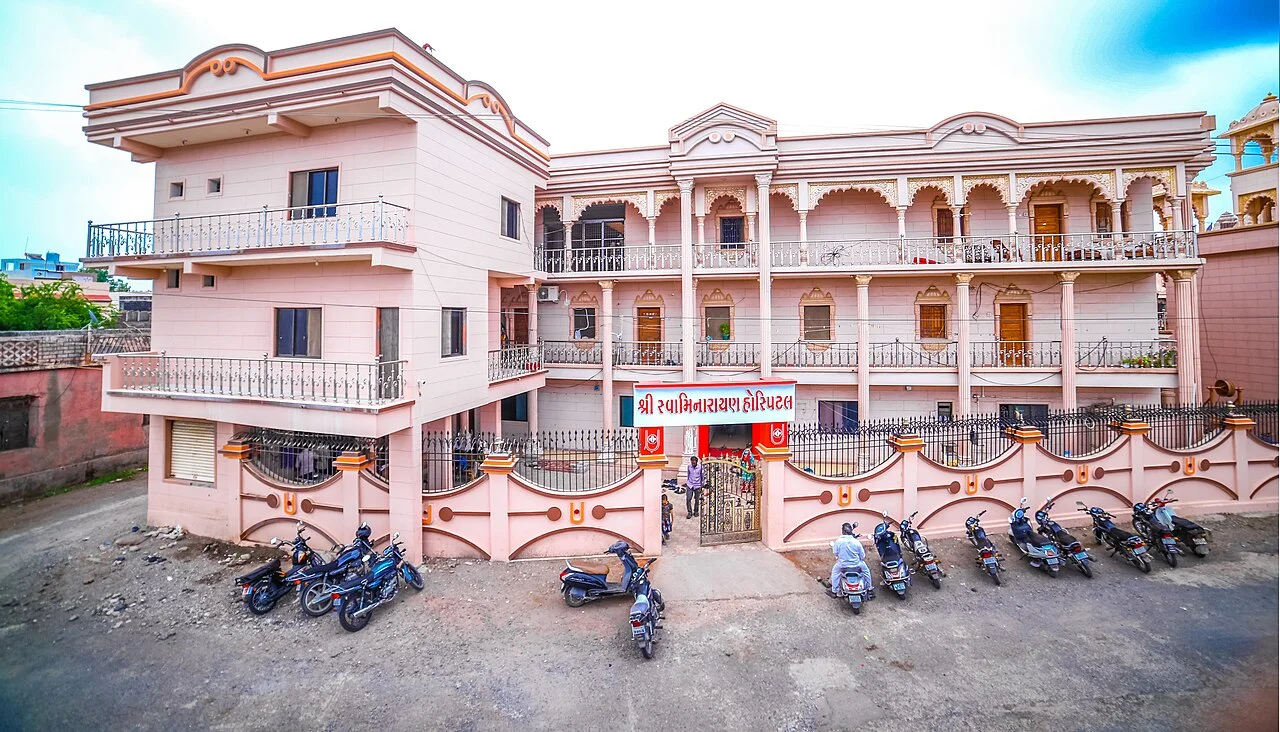
Rural hospital facility in Sardhar, Rajkot district, Gujarat. Community health centres and rural primary health facilities provide the critical first line of outpatient consultations, maternal care, and emergency stabilization across Gujarat's talukas. Photo: MainTempleSardhar / Wikimedia Commons (CC BY-SA 4.0)
Most public conversations about healthcare center on multi-specialty civil hospitals with crowded outpatient blocks and specialist wings. For the majority of Gujarat's rural population, however, primary care begins and ends at local clinics: Sub Centres, Primary Health Centres (PHCs), and Community Health Centres (CHCs). These peripheral facilities handle routine deliveries, infant immunisation, diagnostic screenings, and basic emergencies before patients ever require referral to a district hospital.
Administrative records from Gujarat's 2026–27 health budget, the central Ministry of Health and Family Welfare, and the Comptroller and Auditor General (CAG) establish the operational reach and structural bottlenecks of this network.
The Three-Tier Rural Healthcare Pyramid
India's rural healthcare architecture relies on three graduated tiers designed to deliver primary treatment close to villages and escalate complex cases upward:
- Sub Centres (SC): Peripheral primary care units staffed by Auxiliary Nurse Midwives (ANMs) and Multi-Purpose Health Workers.
- Primary Health Centres (PHC): Staffed clinics led by a Medical Officer, providing outpatient diagnosis, deliveries, and basic laboratory services.
- Community Health Centres (CHC): 30-bed referral facilities with surgical, obstetric, and pediatric capability.
Under the national Ayushman Bharat program, existing Sub Centres and PHCs are being upgraded into Ayushman Arogya Mandirs (AAMs). An Ayushman Arogya Mandir is an upgraded facility offering expanded non-communicable disease screening and essential medicine dispensaries, not an additional bureaucratic tier. As of 10 September 2026, the official national portal records 1,87,085 functional Ayushman Arogya Mandirs across India, including 1,34,786 upgraded Sub Centres and 24,509 upgraded PHCs.
1. Sub Centres: The First Point of Care
Sub Centres operate at the outermost periphery of the public health system.
- Staffing: Typically staffed by one Auxiliary Nurse Midwife (ANM), one male Multi-Purpose Worker, and accredited social health activists (ASHA).
- Target Population: Public health guidelines set a target catchment of 3,000 residents in hilly or tribal areas and 5,000 in plains habitations.
- Core Services: Maternal antenatal care, universal infant immunisation, family planning, infectious disease reporting, and distribution of essential medicines. Upgraded Ayushman Arogya Mandir Sub Centres conduct blood pressure and blood sugar screenings for adults.
2. Primary Health Centres: First-Line Physician Care
The Primary Health Centre (PHC) provides physician-led care and acts as the administrative bridge between village Sub Centres and sub-district hospitals.
- Staffing: Mandated to operate under a qualified Medical Officer (MBBS), supported by staff nurses, pharmacists, and lab technicians.
- Target Population: Planned for 20,000 residents in tribal or hilly terrain and 30,000 in plains.
- Core Services: Outpatient consultations, 24-hour emergency delivery services where residential staff is posted, diagnostic pathology testing, and referral coordination.
- Operational Reality: While guidelines encourage 24-hour delivery coverage, round-the-clock availability in practice depends on local staff postings and medical officer retention.
3. Community Health Centres: The 30-Bed Referral Hub
The Community Health Centre (CHC) functions as a secondary referral unit between rural clusters and the district civil hospital.
- Target Population: Designed to serve 80,000 people in tribal areas and 1,20,000 in plains.
- Mandated Specialties: Indian Public Health Standards (IPHS) require four specialist disciplines: general medicine, general surgery, obstetrics and gynecology, and pediatrics.
- Facilities: 30 inpatient beds, an operation theatre, labor room, X-ray unit, laboratory, and blood storage facility.
- Staffing Reality: A facility designation does not ensure full specialist availability. State health audits show chronic shortages of surgeons and gynecologists in interior talukas.
Gujarat's Healthcare Infrastructure Count (2026–27 Budget Record)
Official departmental data presented during Gujarat's 2026–27 legislative budget session by Minister of State for Health Praful Pansheriya records the active rural network:
Gujarat Primary Healthcare Facilities (2026–27 Budget)
- Sub Health Centres: 9,231 active village facilities.
- Primary Health Centres (PHCs): 1,539 physician-staffed clinics.
- Community Health Centres (CHCs): 353 taluka-level referral hospitals.
By comparison, the Ministry of Health and Family Welfare's Health Dynamics of India (Infrastructure and Human Resources) records national benchmarks across 28 states and union territories: 1,69,615 Sub Centres, 31,882 PHCs, and 6,359 CHCs. Gujarat accounts for roughly 5.4% of all operational Sub Centres and 4.8% of primary health centres in India.
Budget Allocation: Tracking Gujarat's 2026–27 Health Outlay
The Gujarat Legislative Assembly approved ₹25,403.23 crore in budgetary demands for the Health and Family Welfare Department for fiscal year 2026–27, representing an 8.63% increase over the previous fiscal cycle. Key line items include:
- ₹2,017 crore earmarked for healthcare access in remote and tribal areas.
- Targeted allocations for diagnostic laboratory upgrades at taluka CHCs and maternal health monitoring.
PRS Legislative Research's Gujarat Budget Analysis 2026–27 records ₹24,920 crore as estimated departmental expenditure, against the ₹25,403.23 crore gross demand approved on the assembly floor. The difference reflects capital recoveries and net demand accounting rather than budget cuts.
Ground Realities: What Audits Reveal About Staff Vacancies
Facility counts document physical buildings, not doctor attendance or working equipment. Official audit findings highlight persistent staffing vacancies across Gujarat's primary health network:
Audited Deficits in Public Healthcare Delivery
- CAG Audit on Staffing: As cited in the PRS Legislative Research budget analysis, the Comptroller and Auditor General (CAG) documented a 23% vacancy rate among doctors and paramedical staff across Gujarat's public health institutions.
- Specialist Deficits at CHCs: While Community Health Centres are designed to host four specialists, rural postings frequently lack pediatricians and gynecologists, requiring pregnant women to travel to district civil hospitals.
- Geographic Disparities: Coastal Saurashtra and eastern tribal belts face higher vacancy durations compared to central districts surrounding Ahmedabad and Vadodara.
How Citizens Can Verify Local Primary Health Services
Patients and village residents have specific legal mechanisms to inspect and demand healthcare entitlements:
How to Audit Your Local Health Centre
- Inspect Ayushman Arogya Mandir Status: Check whether your local Sub Centre or PHC is registered on the national portal (ab-hwc.nhp.gov.in) and verify if the mandatory list of 14 essential diagnostics and 65 medicines is stocked.
- Review Rogi Kalyan Samiti (RKS) Accounts: Under National Health Mission guidelines, every PHC and CHC operates a Rogi Kalyan Samiti with untied funds. Citizens can request minutes of RKS meetings and local expenditure audits.
- File an Online RTI for Medical Vacancies: Submit an application on Gujarat's RTI portal (onlinerti.gujarat.gov.in) to the Chief District Health Officer (CDHO) requesting sanctioned versus vacant posts of doctors, staff nurses, and lab technicians at your taluka's PHC or CHC.
References & Official Documentation
- Ayushman Arogya Mandir (AAM) Official National Portal, Ministry of Health & Family Welfare
- PRS Legislative Research: Gujarat Budget Analysis 2026–27
- Ministry of Health and Family Welfare (MoHFW), Government of India: Health Dynamics of India (Infrastructure and Human Resources) 2022–23
- Comptroller and Auditor General of India (CAG): Report on Public Health Infrastructure & Staffing in Gujarat
- National Health Mission (NHM) Gujarat State Health Society: Primary Healthcare Service Standards
- Press Information Bureau (PIB) India: Health Sector Allocations and Ayushman Bharat Expansion Updates
Complete Series: Primary Infrastructure & Civic Rights
Article 7: The Other Side of Gujarat's Education Story
Part 5: Informed Citizens Build Accountable Schools
Part 4: RTI: Your Tool for Getting the Real Facts About Your School