Informed Citizens Build Accountable Schools
No child should have to rely on parental connections, village status, or sheer luck to receive what public schools are legally mandated to deliver. Why parent oversight, RTI inquiries, and citizen social audits turn paper rights into working Gujarat classrooms.
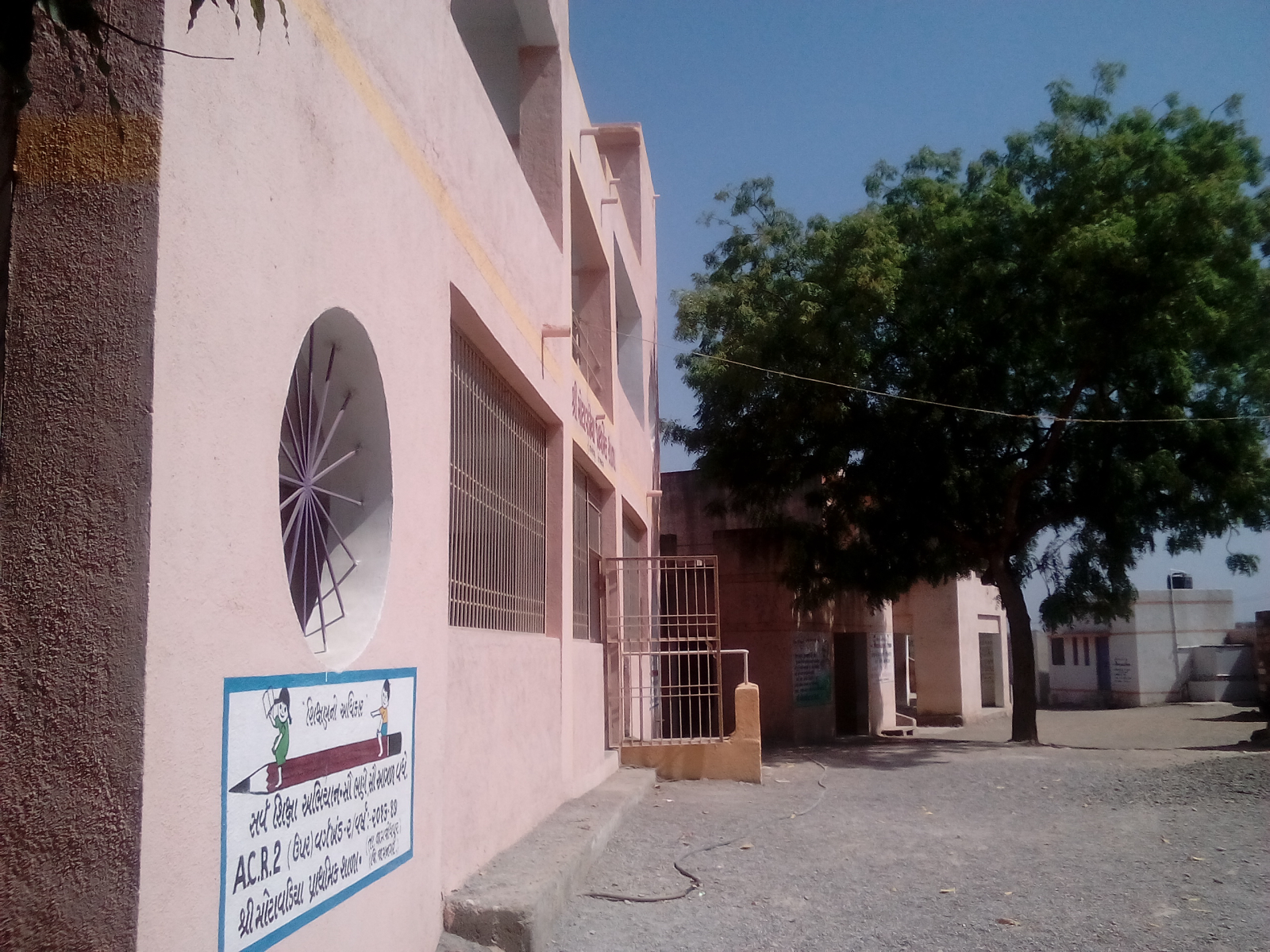
Shree Mota Vadiya Government Primary School in Jamnagar District, Gujarat, displaying official Sarva Shiksha Abhiyan (SSA) and Right to Education classroom sanction markings on its exterior wall. Citizen oversight ensures that sanctioned infrastructure translates into reality on the ground. Photo: Piyush900410 / Wikimedia Commons (CC BY-SA 3.0)
The Quiet Compromise We Make
In village after village across Gujarat, from the salt flats of Abdasa in Kutch to the tribal hamlets of Dahod and Chhota Udepur, parents have learned to make peace with half-measures. If the primary school building has four standing walls, if the mid-day meal arrives on time, and if two teachers show up to manage five grades, families consider it a manageable year.
No child should ever have to rely on their parents' personal connections, a village sarpanch's favor, or random luck to find out whether their school has a clean drinking water filter or enough textbooks. That has been the core premise of this entire series.
Educational rights on paper mean nothing if a child spends their day in a classroom without electricity, drinking unboiled water from a corroded tank, while the official dashboard in Gandhinagar marks the facility as fully functional.
Why Accountability Falls on Parents, Not Just Bureaucrats
A government school is only as accountable as the community standing right outside its front gate. When parents know what the law mandates, when neighbors know what a school budget actually covers, and when someone is prepared to ask a direct question, the dynamic changes immediately.
Take away that watchful eye, and official inertia takes over. Broken toilet latches remain unfixed for three consecutive terms. Sanctioned civil repair grants lapse quietly back to the district treasury. Headmasters learn that no one checks whether the library books stay locked in a metal almirah.
District Primary Education Officers (DPEOs) and Taluka Primary Education Officers (TPEOs) oversee hundreds of institutions across a district. When an official inspection happens, it is almost always scheduled in advance. The courtyard gets swept, attendance registers get updated, and the best-performing students are called forward. The only people who witness the everyday reality are the parents who drop their children off every morning. They see the locked washrooms, the leaking roofs during monsoon storms, and the classrooms left without mathematics teachers.
The Rise of the Social Audit: From RTI to #SchoolTheekKaro
When formal oversight fails to catch basic deficiencies, citizen-led social audits inevitably fill the vacuum. Over recent months, this reality has sparked nationwide attention through grassroots campaigns like the "School Theek Karo" (Fix the School) movement launched by the Cockroach Janta Party (CJP) and activist Abhijeet Dipke.
The premise behind #SchoolTheekKaro is simple: ordinary citizens, youth, and parents walk into local government primary schools with cameras to document the unvarnished reality of rural school infrastructure. They test whether water taps actually flow, check whether separate toilets for girls are functional or padlocked, count how many classrooms are actively in use, and record whether single teachers are left managing four separate grades simultaneously.
What Citizen Social Audits Expose vs. What Portals Report
- Sanitation on Paper vs. Ground Reality: Official data often records "separate girls' toilet available." A physical social audit checks if the door has a working latch, if running water is connected, and if the facility is unlocked during class hours.
- Drinking Water Points: Portals mark schools with a borewell as having drinking water. Ground inspections reveal whether the water is actually potable or if children are bringing bottles from home because the pump is broken.
- Teacher Deployment: Administrative rosters list total staff assigned. An on-site check shows how many teachers are present in classrooms versus those pulled away on administrative or non-academic election duties.
- Physical Safety: While records show "building repaired in 2022," citizen photographs document peeling ceiling plaster, unplastered brickwork, and broken compound walls where cattle wander into school grounds.
State administrations in some regions initially reacted defensively by issuing circulars to restrict school visits or filing police complaints. However, the practical outcome has been clear. When video documentation and citizen audit reports go public, authorities act quickly: contractors return to finish incomplete masonry, water connections get restored, and long-delayed maintenance grants get disbursed.
The lesson for Gujarat is straightforward: viral visibility gets attention, but combining that public energy with formal administrative tools creates lasting accountability that bureaucrats cannot ignore.
Knowledge Does Not Sit Still: The Causal Chain of Reform
True reform follows a direct, predictable chain of cause and effect:
Initial Information → Factual Questions → Physical Verification → Administrative Correction
The Right to Education (RTE) Act sets the baseline entitlement: what your child has a constitutional claim to receive. The Right to Information (RTI) Act provides the mechanism to check whether that claim is being delivered. When a parent knows Section 19 infrastructure norms, they know what to look for. When they know how to spend ₹20 on a targeted RTI query, they can obtain the contractor's completion certificate and verify whether the money allocated for school repairs was spent properly.
Gujarat has invested heavily in digital monitoring systems, most visibly through the Vidya Samiksha Kendra (VSK) in Gandhinagar. VSK tracks student attendance and teacher biometric logs from a high-tech central dashboard. But an algorithm in Gandhinagar cannot smell whether a toilet has been cleaned this week, nor can it tell if children are drinking contaminated water. High-tech monitoring is only as good as the ground truth that verifies it.
Entering the School Gate Was Never the Whole Point
The right to education was never just about getting children past the school gate. Enrolment is a metric; education is an experience. If a child arrives at school only to sit on a cold floor in a crowded multi-grade room with no drinking water, the legal promise of Article 21-A remains broken.
Throughout this five-part series, we have examined every link in this chain:
- Part 1: The specific infrastructure benchmarks mandated under Section 19 of the RTE Act.
- Part 2: How responsibilities split between NCERT, GCERT, and state authorities, and where accountability falls through the cracks.
- Part 4: How a ₹20 RTI application under the Gujarat RTI Rules 2010 pierces administrative silence to reveal staffing rosters and expenditure ledgers.
- Part 5: How citizen vigilance, active School Management Committees, and social audits bring these pieces together to demand working classrooms.
Four Concrete Steps Every Gujarat Citizen Can Take
Fixing public schools does not require running for office or filing high-court litigation. It begins with four practical actions any citizen can take this week:
Your Civic Action Checklist
- Check Your School Management Committee (SMC): Under Section 21 of the RTE Act, 75% of committee members must be parents. Ask your child's school who the parent members are, when the last meeting was held, and request to see the School Development Plan.
- Cross-Check Official Data on UDISE+: Visit the official UDISE+ portal (udiseplus.gov.in) and enter your school's 11-digit UDISE code. Compare what the portal reports about drinking water, boundary walls, and student-teacher ratios with what you see with your own eyes.
- Document & File an Inquiry: If you observe broken infrastructure or unaddressed teacher vacancies, use Gujarat's online portal (onlinerti.gujarat.gov.in) to ask the Taluka Primary Education Officer for repair sanction orders. You can also upload timestamped photographs to civic mapping registries like KnowYourGujarat to create a public, searchable record.
- Support Community Social Audits: Join hands with other parents and community members in constructive social audits through formal SMC petitions or civic initiatives like #SchoolTheekKaro. Focus on facts: specific repairs needed, dates reported, and official responses received.
It starts with asking a single respectful, informed question at your local primary school. When parents stop looking away, government schools start working.
References & Official Documentation
- Vidya Samiksha Kendra (VSK): Command & Control Centre for Schools, Gandhinagar, Government of Gujarat
- Gujarat RTI Online Portal & Gujarat RTI Rules, 2010: General Administration Department, Government of Gujarat
- UDISE+ Official Dashboard: Department of School Education & Literacy, Ministry of Education, Government of India
- UDISE+ School Profile & Facilities Report (Infrastructure & Teacher Statistics)
- Model School Management Committee (SMC) Guidelines under Section 21, Right to Education Act, 2009
- KnowYourGujarat Civic Infrastructure Directory: Public Education Dataset across 33 Districts
- Photo Attribution: Shree Mota Vadiya Primary School, Jamnagar, Gujarat by Piyush900410 via Wikimedia Commons (CC BY-SA 3.0)